DESIGNED BY RIDERS, FOR RIDERS
How to Wash Horse Riding Clothes the Right Way: Preserving Performance and Fit

Modern equestrian apparel represents a sophisticated fusion of athletic textile engineering and tailored heritage style. Today's riders no longer train in stiff, untreated cottons; they rely on 4-way stretch polymers, hydrophilic microporous membranes, bonded silicone grip matrices, and antimicrobial yarn weaves. However, these specialized materials face an aggressive environment unlike any standard sportswear: abrasive leather tack, acidic horse sweat, high-friction arena sand, lanolin oils, and volatile stable dust.
Tossing your technical riding wardrobe into a standard hot wash cycle with commercial detergents is the fastest route to ruining it. Aggressive agitation fractures elastane recovery, standard surfactants dissolve the molecular bonds of silicone seat patterns, and synthetic fragrances clog moisture-wicking capillary channels. Implementing a tailored horse riding clothes care routine is not about fussy laundry habits; it is an investment in gear longevity, thermal regulation, and saddle security.
Whether you maintain high-recovery schooling gear from our curated mens equestrian horse riding apparel or invest in the contoured silhouettes of womens equestrian horse riding apparel, following precise textile maintenance preserves the functional integrity of every garment.
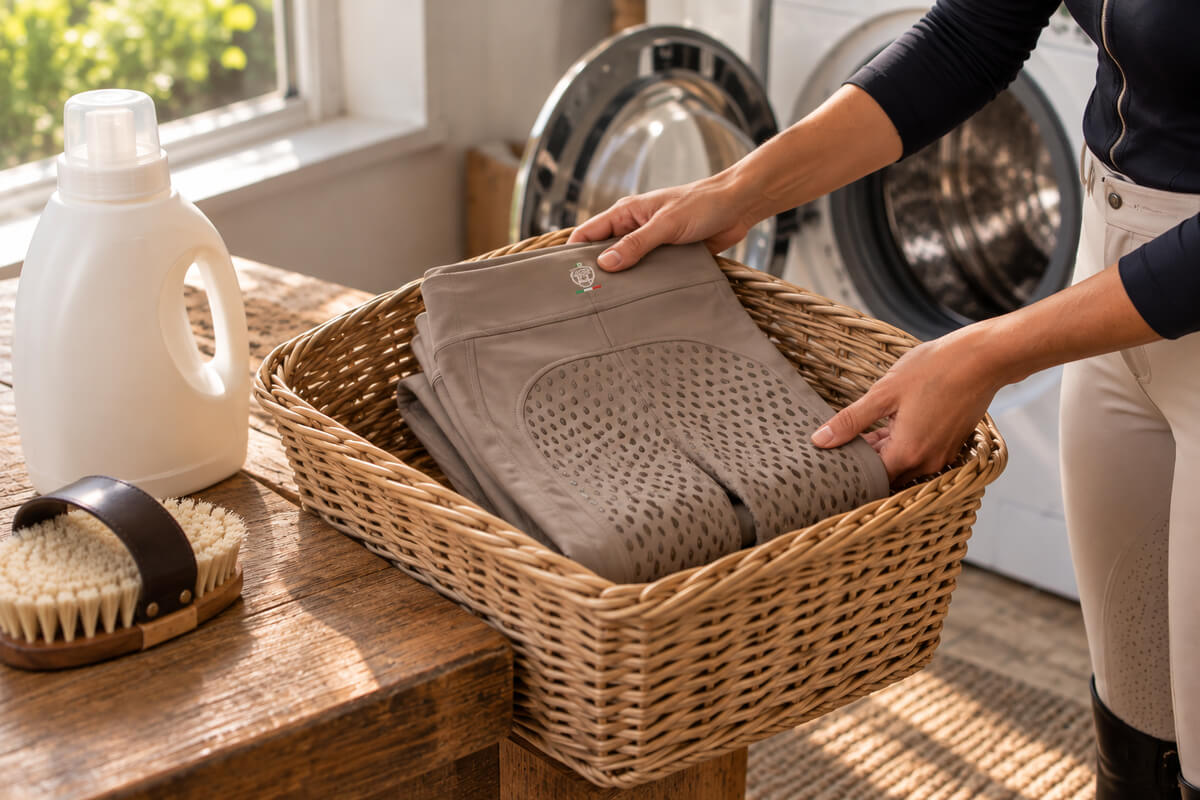
Why Equestrian Clothing Needs Special Care
Understanding why technical riding clothes require dedicated laundering begins with examining the mechanical and chemical stresses unique to horse riding.
The Abrasive Compound Effect: During a single flatwork or jumping session, thousands of repetitive friction cycles occur between your breeches, the saddle leather, and fine quartz arena sand. This grit embeds itself deep within the textile weave. In a regular washing machine cycle, spinning these sandy garments acts like fine liquid sandpaper against technical synthetic fibers, weakening structural yarns and causing pilling.
Acidic Sweat Breakdown: Both equine and human perspiration contain high concentrations of sodium chloride, urea, and acidic lactic compounds. When left dried inside technical knitwear, these crystallized mineral salts dry out elastane strands, accelerating fiber fatigue, loss of recovery, and premature fabric sag around the knees and seat.
Membrane and Coating Vulnerability: Technical equestrian tops feature specific finishes: durable water-repellent (DWR) surface coatings, anti-odor silver-ion infusions, and micro-mesh venting zones. Standard laundry practices strip these specialized finishes, transforming high-tech gear into limp, non-breathable cloth.
How to Wash Riding Breeches Without Damaging the Grip
Silicone full-seat and knee-patch breeches have transformed saddle stability, but they remain the most laundering-sensitive item in your riding locker. High temperatures and chemical additives cause silicone prints to bubble, crack, peel, or turn unpleasantly sticky.
Pre-Wash Sand Extraction: Never place breeches straight from the barn into the wash drum. Turn them right side out first and vigorously shake or hand-brush dried arena sand off the seat, seams, and ankle cuffs.
Turn Breeches Inside Out: Always reverse your breeches before washing. This shields the silicone grip dots from friction against zippers, buttons, or the stainless steel washing drum.
Zip and Fasten Hardware: Fasten all front slide clasps, hook-and-eye closures, and ankle velcro tabs. Open velcro acts like a wire brush against technical stretch fabrics during the wash cycle.
Water Temperature Calibration: Wash exclusively in cold or lukewarm water, never exceeding 30°C (86°F). Water hotter than 30°C degrades the thermal bonding adhesives anchoring the silicone grip to the base fabric.
Cycle Selection: Select a gentle synthetic or sportswear cycle with a low spin speed (maximum 600–800 RPM) to minimize mechanical torsion on the seat seams.
How to Wash Base Layers and Technical Riding Tops
Base layers sit directly against your skin, managing perspiration and core body temperature through capillary moisture transfer. Washing them improperly traps odor-causing bacteria within synthetic microfibers.
Preserving Capillary Channels: Technical base layers use channeled synthetic yarns designed to pull liquid sweat away from your skin toward the outer face for rapid evaporation. Standard powder detergents often leave chalky residues that fill these microscopic channels, neutralizing moisture management. Always opt for a mild liquid sports detergent formulated to rinse away completely clean.
Managing Persistent Stable Odors: Because synthetic fibers are lipophilic (oil-attracting), they readily absorb body sebum and stable odors that survive standard wash cycles. To banish stubborn stable smells without compromising fabric integrity:
Pre-soak smelly base layers for 30 minutes in cold water with half a cup of distilled white vinegar.
Avoid chlorine bleach or oxygen-bleach boosters, which permanently break down the elastane recovery fibers, resulting in loose, baggy necklines and stretched cuffs.
Zip Protection: Quarter-zip collars should always be zipped fully to the top before entering the drum to avoid the brass or nylon teeth snagging fine micro-mesh inserts.
How to Care for Competition Shirts and Jackets
Competition apparel demands the highest level of care: pristine white collars, bib plackets, and structured show coats must retain crisp silhouettes under judge scrutiny.
Competition Shirts and Show Tops
Targeted Collar and Cuff Pre-Treatment: Apply a gentle, dye-free stain pre-treatment stick directly to makeup lines, sweat rings on inner collars, and cuff stains before washing.
Mesh Wash Bags Are Essential: Place delicate white competition shirts inside a fine mesh washing bag to prevent snagging on hooks or buttons from other garments.
Whiteness Retention: Wash white show apparel strictly with other pure whites. Washing white technical shirts with light greys or pastels gradually turns technical polyester an irrecoverable dull, dingy grey.
Technical Show Jackets and Softshell Coats
Check the Care Label: Most modern technical show coats are constructed from bonded softshell that can be machine-washed on a hand-wash or wool setting, but structured wool-blend hunt coats strictly require specialized professional dry cleaning.
Spot-Clean Post-Show Maintenance: Minor splashes of ring mud on softshell coats do not require a full machine wash. Let the mud dry completely, brush it off with a soft clothes brush, and wipe the area with a damp microfiber cloth.
Hanger Preservation: When machine washing is necessary, use a cold, gentle cycle with zero spin. Remove immediately, shake out excess water gently, and hang the jacket on a broad-shouldered wooden hanger to dry naturally without wrinkling.

Should You Use Fabric Softener on Riding Clothes?
The direct answer is an unequivocal no. Fabric softener is the single most destructive agent for technical equestrian apparel.
How Fabric Softeners Damage Technical Wear: Fabric softeners work by depositing an ultra-thin, waxy chemical film of silicone or quaternary ammonium compounds over fabric fibers to make them feel artificially silky. On technical riding gear, this waxy coating:
Smothers Moisture Transport: It forms a hydrophobic barrier over capillary fibers, locking sweat inside the garment rather than allowing it to evaporate.
Destroys Silicone Grip: It chemically degrades the adhesives holding silicone patterns to breeches, causing the grip to dissolve or peel.
Breaks Down Elastane: The chemical plasticizers weaken spandex, causing garments to sag and lose their compression qualities.
Traps Stable Bacteria: The waxy film seals bacteria inside the yarn weave, permanently locking in that notorious sour stable odor.
Instead of fabric softeners, add two tablespoons of white distilled vinegar to the fabric softener dispenser drawer. The natural acetic acid breaks down residual detergent minerals and naturally softens fibers without leaving a chemical residue.
How to Dry and Store Equestrian Clothing
The laundering process is only half the battle; how you dry and store your riding wear dictates how many seasons it will endure.
The Tumble Dryer Hazard: Never place riding breeches, base layers, or competition garments into a tumble dryer. The convective hot air bakes and melts silicone grip elements, shrinks elastane blends, and weakens seam bonding tape. Always air-dry technical garments.
Best Drying Protocols
Flat Drying for Heavy Knits: Lay technical sweatshirts, hoodies, and thick breeches flat across a drying rack away from direct sunlight to prevent fiber stretching and UV fading.
Hanger Drying for Tops: Hang base layers and show shirts on smooth plastic or padded hangers in a well-ventilated room.
Avoid Direct Heat Sources: Never place wet technical clothing directly over radiators or space heaters, as concentrated contact heat permanently deforms synthetic polymers.
Proper Stable Wardrobe Storage: Ensure every garment is completely dry before placing it into your stable locker or closet. Moisture trapped in enclosed tack rooms fosters mildew spores that attack synthetic fabric membranes and degrade leather trims. Store off-season apparel folded inside breathable cotton garment bags, using natural cedar blocks to ward off moisture and insects.
By mastering the science of technical garment maintenance, you preserve the precise fit, vibrant color, and athletic grip of your equestrian wardrobe—keeping you looking impeccably turned out and performing at your absolute best ride after ride.
Editor's Note: If your breeches' silicone grip ever feels slick or loses traction from accidental softener contamination, hand-wash the grip zone with warm water and a few drops of grease-cutting clear dish soap using a soft microfiber cloth to strip the waxy residue.